What if healing trauma required more than understanding what happened to you? What if the rhythm of a horse's footsteps, the experience of connection, and the movement of your own body could become part of the healing process?
For many trauma survivors, knowing they're safe and actually feeling safe are two very different experiences. And understanding why requires looking at how our brains develop in the first place.
The Brain Develops From the Bottom Up and Inside Out
From our earliest moments of life in utero, our brains are shaped through sensory experiences, movement, rhythm, and relationships.
According to Dr. Bruce Perry's neurosequential model, brain development follows a broadly bottom-up, inside-out pattern. Foundational systems involved in survival, bodily regulation, and sensory processing mature early, while networks supporting emotional relationships, reasoning, and complex decision-making develop over time.
These systems are deeply interconnected, but we can think about four important regions:
The brainstem helps regulate foundational functions such as breathing, heart rate, and arousal.
The diencephalon includes structures involved in sensory processing, movement regulation, and maintaining internal balance.
The limbic system involves networks important for emotion, memory, attachment, and interpreting experiences.
The prefrontal cortex supports higher-level functions such as reflection, planning, emotional regulation, and making intentional choices.
Healthy functioning depends on ongoing communication between these regions. Our ability to think clearly, recognize emotions, and respond flexibly to our environment relies on these interconnected systems working together.
What Happens to the Brain During Trauma?
Whether we're talking about Big T trauma, such as assault or a serious accident, or little t trauma, such as repeated criticism, emotional neglect, or relational distress, overwhelming experiences can influence how our nervous systems respond to the world.
When the brain detects danger, survival-oriented processes take priority. Our attention narrows, our bodies prepare to respond, and reflective thinking may become less accessible.
For people with unresolved trauma, these responses can persist or become activated in situations that are no longer dangerous.
It's as though the brain's alarm system has become exceptionally well practiced, while communication with the systems responsible for perspective, emotional regulation, and present-moment awareness becomes less flexible.
This is one reason someone can intellectually recognize that they're safe while their body continues responding as though danger is imminent.
Why Rhythm and Movement Matter in Trauma Healing
If our earliest experiences of regulation are rooted in sensation, movement, rhythm, and relationship, it makes sense to consider those experiences in trauma recovery.
Perry's model emphasizes the value of beginning with regulation, building relational safety, and supporting higher-level processing. This is often described as regulating, relating, and reasoning.
Rhythmic, repetitive activities such as walking, rocking, drumming, and dancing can provide predictable sensory experiences that support regulation for some individuals.
And this is where horses offer a particularly interesting therapeutic opportunity.
How Mounted EMDR Can Engage Multiple Brain Systems
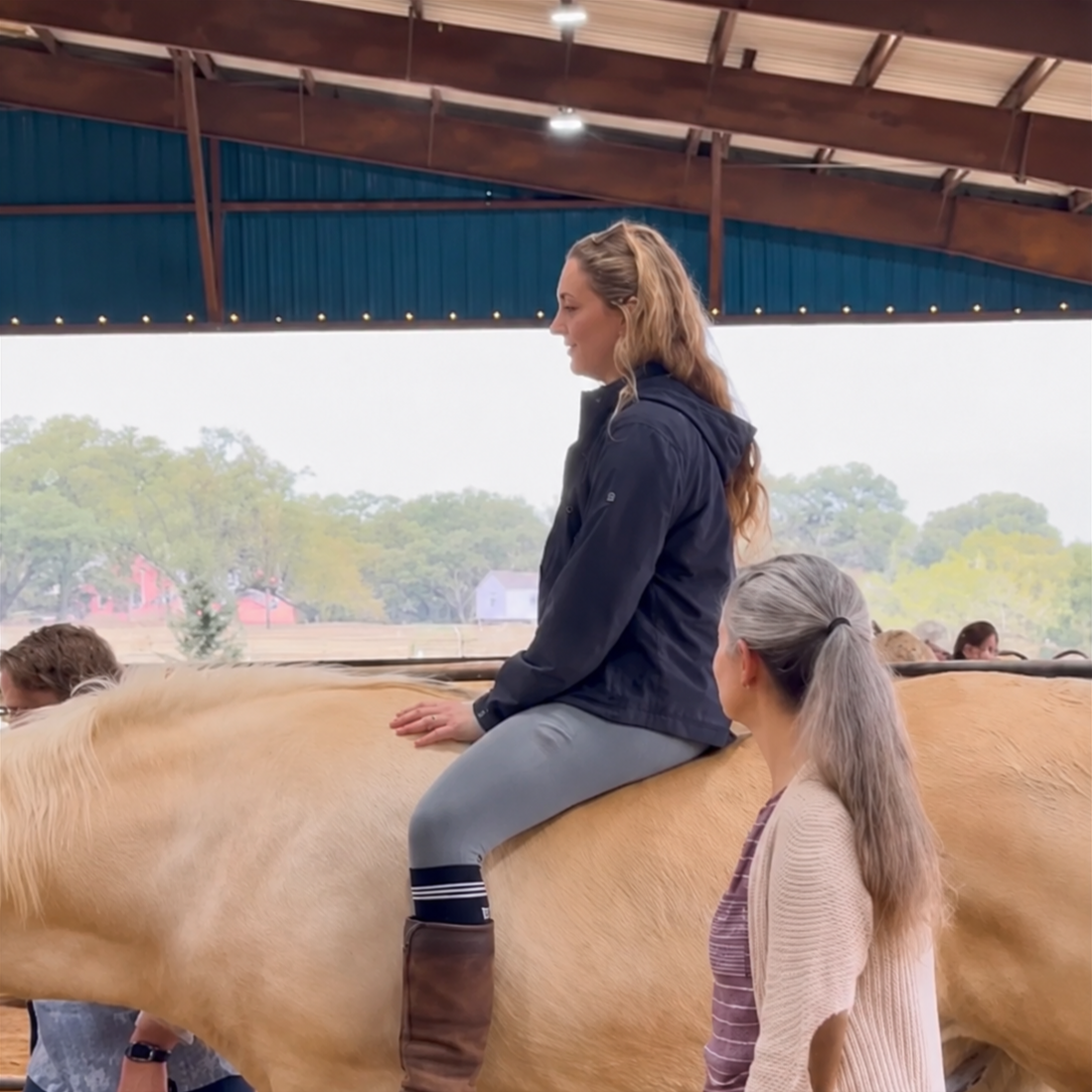
Imagine participating in an Equine-Connected EMDR session while mounted on a horse.
As the horse walks, its steady, three-dimensional movement provides sensory input throughout your body. At the same time, you're participating in a relationship with another living being while your therapist guides your attention and trauma processing.
Consider what might be happening across these interconnected brain systems.
Brainstem: Experiencing Rhythm and Regulation
The repetitive movement of the horse provides patterned sensory input while the brainstem participates in regulating arousal, breathing, and other foundational bodily functions. This predictable rhythm may support a more regulated state, depending on the individual's response.
Diencephalon: Organizing Sensation and Movement
As the horse moves beneath you, your body continuously adjusts to maintain balance. Sensory and motor networks, including pathways involving the thalamus, cerebellum, and vestibular system, coordinate information about movement, posture, and body position.
Rather than simply thinking about your body, you're actively experiencing it.
Limbic System: Experiencing Connection and Emotional Safety
You're also in relationship with the horse.
Noticing its responses, communicating through your body, and experiencing moments of mutual responsiveness create opportunities to explore trust, boundaries, vulnerability, and emotional awareness.
With appropriate therapeutic support, these experiences may offer new ways of relating to another being without relying on old protective patterns.
Prefrontal Cortex: Engaging Attention, Awareness, and Choice
Now imagine your therapist invites you to count the horse's footsteps aloud.
One, two. One, two.
You're maintaining attention, coordinating language with movement, noticing your surroundings, and making intentional choices while your body continues responding to the horse's rhythm.
When clinically appropriate, your therapist may also incorporate EMDR reprocessing, supporting you in noticing and processing distressing memories, sensations, emotions, and beliefs.
Why Bringing These Experiences Together Matters
The beauty of this approach is that movement, sensory processing, emotional connection, and conscious awareness are happening together.
Trauma can disrupt flexible coordination between the brain systems involved in threat detection, bodily awareness, emotional processing, and reflective thought.
In mounted equine-connected therapy, we're intentionally creating opportunities for these functions to participate in a shared experience.
The horse's movement provides rhythmic sensory input. The relationship creates opportunities for emotional connection. Counting and intentional attention engage cognitive processes. EMDR provides a structured framework for processing traumatic memories.
This is a clinically meaningful way to think about supporting integration, although research has not yet established that mounted EMDR directly reorganizes all these brain regions or produces better outcomes than standard EMDR.
Healing From the Bottom Up
Trauma healing isn't always about finding the right words to explain what happened. Sometimes it's about helping the body experience something different while the mind begins making new connections.
A sense of steadiness where there was once fear. Connection where there was once isolation. Choice where there was once helplessness.
At A Place Along the Way, our private Equine-Connected EMDR Intensives in the Colorado mountains bring together evidence-based trauma therapy, intentional movement, and relationships with horses.
Because healing isn't simply about teaching the thinking brain that the danger has passed. It's about creating opportunities for the whole person to experience and integrate that understanding.
